
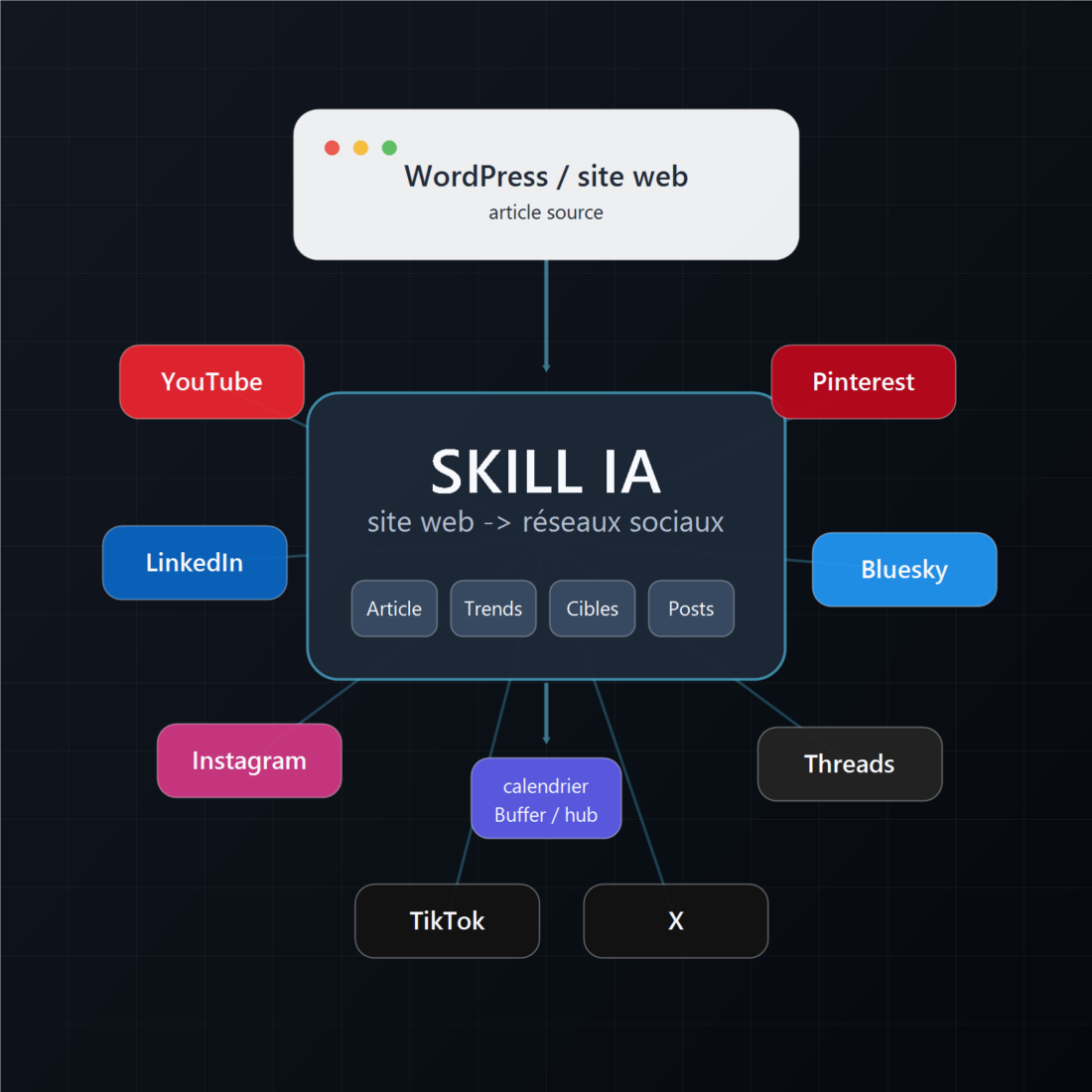
Publishing an article on a website is not the end of the work. It must still be adapted for social media: LinkedIn, X/Twitter, Instagram, YouTube, Threads, Bluesky, Mastodon, Pinterest, or Google Business. Copy-pasting the same text everywhere is fast, but it rarely produces a high-quality post.
The Blanc Lab approach is more compelling: creating a social publishing AI skill. This skill provides Codex, or any other AI agent, with a precise professional framework to transform a published article into posts tailored for each network, then prepare them in Buffer or an equivalent tool.
Buffer serves as a concrete example here. Other platforms can play the same role, such as Hootsuite, Metricool, Later, or Sprout Social. The core of the method is not the final tool: it is the skill—the professional expertise encoded into the AI. Once a method works for two networks, it can be extended to other connected channels.
Why create an AI skill
A generic prompt asks the AI to “make a post.” A professional skill goes further. It defines:
- target audiences per network;
- the expected tone for each social network;
- length constraints;
- hashtag logic;
- the inclusion of a link to the article;
- the preparation of images and alt texts;
- human validation before publication.
The skill does not replace the social media manager. It formalizes their expertise to make it reusable, fast, and controllable.
Skill creation method
- Define target networks: LinkedIn, X/Twitter, Instagram, YouTube Shorts, Threads, Bluesky, Mastodon, Pinterest, or Google Business.
- Write an editorial rule for each network: audience, length, tone, angle, and image usage.
- Define mandatory inputs: article URL, title, excerpt, categories, tags, featured image, and captions.
- Create a targeted writing algorithm: extract the subject, identify keywords, choose the angle, and then adapt the message for each audience.
- Add web monitoring: Google searches, news signals, keyword trends, used hashtags, and industry-specific vocabulary.
- Categorize hashtags based on relevance, specificity, current usage, and suitability for the specific network.
- Generate alt texts based on captions or image descriptions.
- Prepare posts in Buffer or another distribution hub, awaiting human validation.
- Test the skill on several articles, correct the outputs, and then stabilize the rules.
This monitoring step is essential. It prevents the AI from writing in a vacuum. The skill can request research on the topic before finalizing the hook: what are companies looking for, which words are circulating, which terms are too vague, and which hashtags remain credible?
Usage method
- Provide the public URL of the published article.
- Automatically extract title, excerpt, tags, images, and SEO angle.
- Launch keyword and trend monitoring.
- Generate a professional version for LinkedIn.
- Generate a short, technical version for X/Twitter.
- Prepare visual or short variations for Instagram, Threads, Bluesky, YouTube, or other useful channels.
- Add links, hashtags, and image descriptions.
- Create posts ready for validation in Buffer.
- Review, adjust, schedule, or publish.
Once the system is configured, the objective is clear: produce high-quality posts ready for validation on one or two networks in under two minutes, and a few minutes for broader distribution. The gain comes not just from speed, but from repeatability.
Technical AI, not magic
The type of AI used here is an editorial production agent: a language model driven by professional rules, connected to tools, capable of reading an article, gathering context, structuring a response, and preparing an action.
Codex is a prime example because it can combine writing, files, APIs, automation, and quality control. But the principle can exist elsewhere: the key is to link an AI model to a clear skill, then to a publication tool.
For a company, this transforms social publishing into a system: one article becomes several messages, each targeting a specific audience, while the human retains final decision-making power. This is exactly the Blanc Lab domain: creative engineering, AI, and useful automation.