
When a market shifts, the first instinct is often to look for a tool: a new website, a payment module, an advertisement, or a more modern platform. But in a small business, the real issue is rarely the tool alone.
The real issue is the workflow. And what that workflow takes away, day after day, from the core of the craft.
At Grain Noir, a Swiss artisan roaster based in La Sarraz, the Covid period made this reality very concrete. Restaurants closed, companies emptied their cafeterias, and purchasing habits shifted toward the home. For an SME that sold to restaurateurs, wholesalers, corporations, and individuals alike, online sales were no longer just a secondary channel. It was becoming a necessity.
This case is not a universal recipe. Rather, it demonstrates a way of approaching digital transformation: starting not with the storefront, but with the actual work hidden behind every order.
The problem wasn’t just commercial
Before the transformation, orders arrived through multiple channels: telephone, email, an old e-commerce site, professional clients used to calling directly, and individuals discovering online shopping.
On paper, this mix could work. In reality, every order triggered a series of manual steps:
- verifying or creating the customer;
- entering the order;
- producing or preparing the coffee;
- issuing the invoice;
- printing or sending documents;
- occupying already limited storage space;
- preparing the package;
- managing labels and the carrier;
- tracking payment or the invoice.
An order was therefore not just a sale. It was a small administrative, logistical, and commercial chain.
As long as volume remained moderate, this organization could be sustained by human commitment. But when the internet channel began to gain more weight, friction became visible: double entry, risk of error, slow delivery, lack of structured customer history, and difficulty in applying different prices based on segments.
There is also a subtler but decisive effect: in a small business, these tasks eventually take up space within the core craft itself. The artisan roaster must roast, follow recipes, guarantee quality, and bring their product to life. If storage, picking, packing, and administrative re-entry consume too much energy, the real value of the company begins to be cannibalized by its own operations.
Digitizing a business workflow often starts with accepting that the problem isn’t the screen, but what it still forces humans to do behind it.
Connecting tools rather than stacking them
The solution was therefore not simply to “redo a site.” The site had to become an order engine capable of communicating with the rest of the company.
The choice moved toward an architecture where PrestaShop handled the e-commerce side and Bexio managed the ERP, invoicing, and accounting. The challenge was to link these components to ensure that every order didn’t have to be re-entered, copied, or processed manually.
This connection allowed several dimensions to be structured simultaneously:
- online orders;
- customer profiles;
- tiered pricing;
- payment methods;
- invoices and confirmations;
- data useful for commercial tracking.
For individuals, this meant being able to order and pay more simply. For professional clients, it meant maintaining specific commercial conditions. And for the Grain Noir team, it meant gaining a clearer view of what was selling, to whom, at what pace, and through which channel.
The nuance is important: a good digital transformation doesn’t necessarily force all customers to change their habits. In this case, it was also necessary to allow the team to take an order over the phone on behalf of a professional client, with their specific rates and conditions. The telephone remained a real-world use case. The tool had to integrate it, not deny it.
Logistics is part of digital
In many e-commerce projects, the thinking stops when the customer clicks “add to cart.” For a company selling a physical product, however, that is where another part of the project begins.
Coffee must be produced, packaged, stored, prepared, and delivered. In the case of Grain Noir, this reality was even more sensitive: the freshness of the coffee depends on the time elapsed after roasting, degassing, storage, and production pace.
The transformation therefore also applied to logistics and stock. A portion of the inventory was outsourced to Planzer, following a simple logic: reducing the footprint in a small roastery that didn’t have enough space to absorb growth, while entrusting picking, packing, and delivery to a company whose core business is precisely that.
This choice wasn’t just practical. It was a transfer of expertise. Rather than asking an artisanal SME to become a mini-logistics center as well, the project organized the relationship between orders, outsourced stock, and the partner capable of preparing and distributing packages at the right pace.
Daily orders could be grouped, transmitted in a usable format, prepared the next day, and delivered faster. Stock thresholds also allowed for better replenishment planning: when levels dropped, Grain Noir could trigger an appropriate production run instead of working solely under pressure.
This point changes many things. Digital is no longer just the site visible to the customer. It becomes a system that prepares the work of the people handling packages, monitoring stock, and ensuring delivery.
The goal was not to strip the artisan of control. On the contrary: by removing some of the daily administrative, spatial, and logistical noise, the company could focus more on its core business—roasting.
In an SME, digital transformation should not add parasitic roles. It should liberate the core business.
Produce better, not just sell more
Another question emerged behind the sales: how to produce at the right time?
In a very tight organization, production often follows orders on a case-by-case basis. While this can preserve freshness, it also creates interruptions, small batches, frequent changes, pressure on the workshop, and difficulty in forecasting.
Analyzing sales allowed for a better understanding of the most requested coffees, order rhythms, likely volumes, and replenishment needs. The company could then produce certain coffees in more consistent volumes without compromising quality standards.
This transition is at the heart of the project: data isn’t just used for reporting. It is used to reorganize work.
Today, Grain Noir highlights 7 Pure Origin Arabica coffees and publicly announces 6,000,000 cups drunk as well as 50 tons of roasted coffee beans every year in Switzerland. These figures provide the scale: this is no longer just an online shop, but a system where production, ordering, stock, delivery, and customer relations must move forward together.
What the customer sees, what the company absorbs
On the customer side, the transformation translates into simple signs: a readable catalog, 500g or 1kg packaging, payment options, stock status, and a promise of fast shipping.
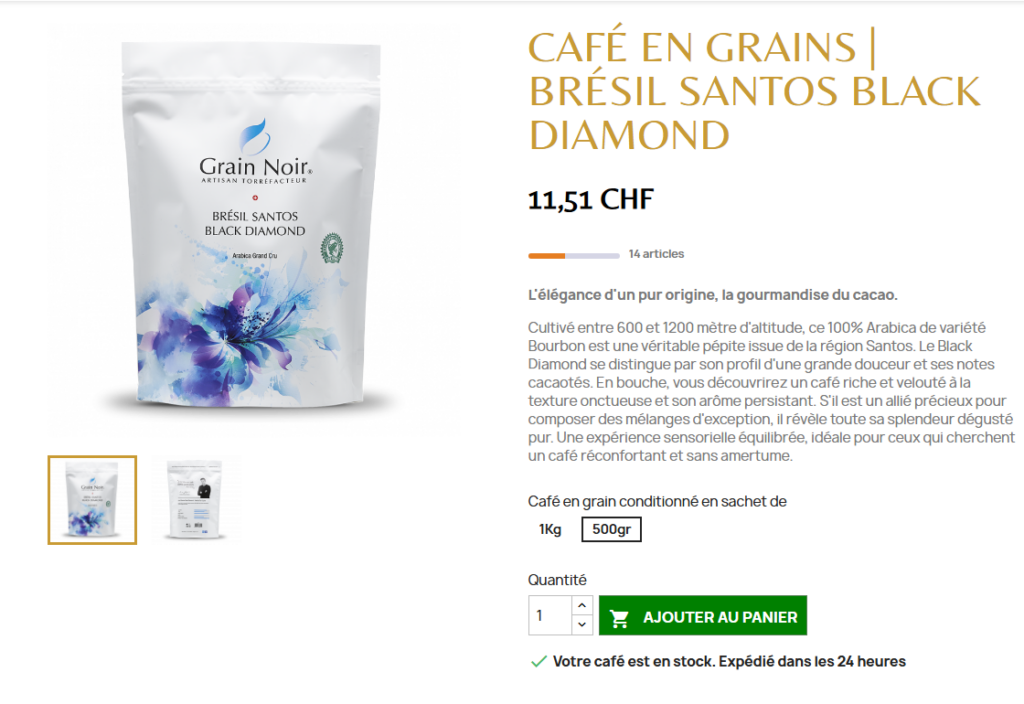
On a product page like the Brazil Santos Black Diamond, we see a standard online purchase example: price, stock, quantity, add to cart, and shipping promised within 24 hours when the coffee is available.
But this apparent simplicity rests on an invisible chain. For the “buy” button to be credible, stock information must be usable, the order must be transmitted, the invoice must go out correctly, the package must be prepared, delivery must be tracked, and the customer must receive a product that matches the promise.
This is often where the digital transformation of an SME takes place: in the gap between what the customer sees in a second and what the company must make reliable every day.
Results as orders of magnitude
According to project data, online sales initially represented a minority share, around 8% to 10%. During the transition period, they were able to rise to approximately 60%.
Delivery times were also significantly compressed: we moved from a process that could take several days to an organization capable of processing daily orders and aiming for next-day delivery.
These figures should be read as orders of magnitude derived from experience, but they clearly convey the essence: the project was not limited to improving an interface. It allowed the company to absorb a surge in demand without a proportional increase in administrative workload.
A method more than a model
What makes this case interesting for other companies is not the specific choice of tools. Another SME could have chosen a different platform, another ERP, or a different logistics partner.
The method, however, remains transferable:
- start from real orders, not the fantasy of an ideal journey;
- map out invisible tasks;
- distinguish what must remain human from what can be automated;
- distinguish what should stay in-house from what can be delegated to a specialist;
- connect tools to avoid double entry;
- preserve useful habits for professional clients;
- use sales data to better produce, stock, and deliver.
A successful digital transformation is not necessarily one that replaces everything. It is often the one that makes the company more legible to itself, helping it understand where its true value lies.
In the case of Grain Noir, the project linked e-commerce, invoicing, payment, customer knowledge, outsourced stock, logistics, and production. It also demonstrated a simple truth: when the market moves fast, the best response is not always to add another layer of technology. It is to automate or delegate what takes the company away from its core business, allowing work to flow more smoothly.