

# Building an AI Ecosystem to Manage Your Business
Artificial intelligence has already moved beyond the demonstration phase. In many organizations, it is no longer just a tool tested out of curiosity, nor a chatbot used occasionally to generate a piece of text. It is becoming a work infrastructure.
This shifts the starting question. It is no longer about whether a company should use AI. Instead, we must ask where to place it, what its limits are, in which business workflows it fits, with what level of human oversight, and with what data.
At Blanc Lab, this shift is very concrete. My work is no longer conceived without Codex, local tools, scripts, APIs, or models capable of helping to translate, categorize, publish, extract, document, or prepare a usable draft. But this new role for AI does not diminish human expertise. On the contrary, it makes it more available.
AI does not create in place of the expert. It relieves them from the tasks that prevent them from going deep into their craft.
An AI Ecosystem, Not Just Another Chatbot
A company does not need an AI tool sitting alongside its usual methods. It needs an ecosystem: cloud models when useful, local models when data must remain internal, business tools, scripts, APIs, a website, a CRM, files, validation rules, and a working memory.
In this ecosystem, ChatGPT, OpenAI, Gemini, Mistral, Codex, Ollama, or open-source models are not isolated solutions. They are building blocks. Their value comes from their combination with real needs: quotes, invoices, content creation, translation, publishing, booking, newsletters, customer follow-up, audio post-production, field data, or internal documentation.
Certain tools then take on complementary roles:
- ChatGPT, OpenAI, Gemini, or Mistral: exploring an idea, structuring a reasoning, comparing approaches, producing initial material, or handling general tasks when the data is not sensitive.
- Codex: working within files, code, folders, and scripts to transform an intention into a tool, a documented routine, or a concrete modification of an existing system.
- Ollama: running open-source models locally to keep certain content on the machine, particularly for translation, controlled rewriting, or internal processing.
- Open WebUI: testing, comparing, and managing local models in a readable interface, useful for choosing the right model before integrating it into a worker or business tool.
- OpenCode: providing a development-oriented assistant to read a project, suggest corrections, generate code, or accelerate technical tasks close to the repository.
- ComfyUI: building visual workflows for image generation, retouching, restoration, and creating custom atmospheres. With FLUX / Kontext, an image can be modified while taking its context into account: changing an atmosphere, correcting a detail, restoring a photo, or keeping a character while transforming the style. The same studio can manage video flows with Wan2.2, moving from text or an image to a short animated sequence, and avatars with InfiniteTalk, which animates an image or video from a voice to produce a speaking, synchronized, and consistent character.
- WordPress, Polylang, Events Made Easy, Brevo, or Outlook: powering the business flows themselves, with data for publishing, translation, booking, newsletters, calendars, or customer relations.
The decisive point is therefore not just the choice of a model. It is interoperability: making systems talk to each other, delivering the right information to the right place, and keeping a record of what has been prepared, validated, or corrected.
AI at the Service of Human Expertise
AI does not replace creation, taste, judgment, responsibility, or relationships. It executes, prepares, links, categorizes, reformats, translates, extracts, pre-fills, and repeats. It becomes valuable when a task consumes time without requiring a creative decision at every turn.
A company can thus delegate part of the repetitive work:
- reformatting information for a quote or an invoice;
- preparing drafts for responses or publications;
- extracting data from a business tool;
- transforming an event sheet into a newsletter;
- translating an article according to a stable editorial framework;
- categorizing content or producing summaries;
- preparing files, exports, or documents ready for review.
The gain is not just speed. It is the recovery of useful time. Less re-typing, fewer scattered manipulations, fewer oversights between two tools: more space to think, research, decide, create, meet, and improve.
Choosing Between Cloud and Local
Not all AI use cases require the same level of confidentiality. Some processes can go through powerful cloud tools. Others benefit from staying on a local machine, especially when content, drafts, customer data, or internal information are sensitive.
This is one of the key aspects of Blanc Lab’s work: not treating AI as a single block. The same ecosystem can use cloud models for general tasks, Codex to orchestrate files and code, and Ollama with open-source models to perform certain processes locally.
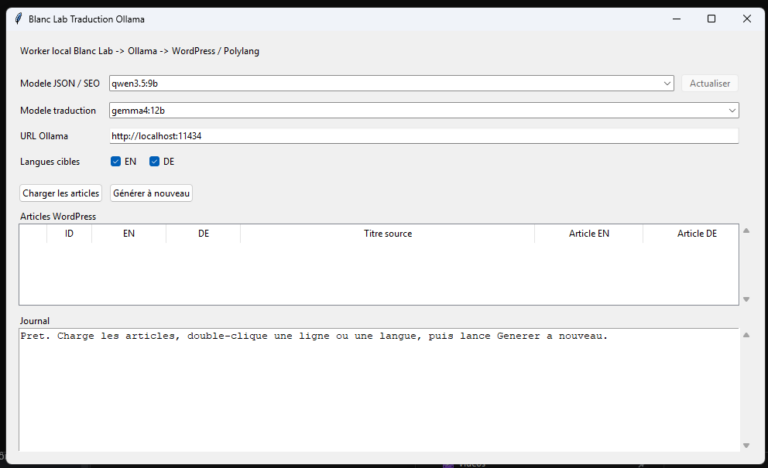
The Blanc Lab translation tool illustrates this approach well. It does not simply “translate a text.” It links WordPress, Polylang, a local worker, Ollama, a glossary, tone guidelines, SEO fields, taxonomies, and output controls. French remains the source of truth. Translated versions are produced through a method, not through improvisation.
In this case, local AI is not an ideological argument. It is a practical response: certain operations can remain on the computer within a controlled framework with explicit business rules.
The Real Issue: Connecting Systems
Most organizations already have too many tools. The problem is not always adding another one. The problem is often that the tools do not communicate well enough with each other.
An activity exists in WordPress or Events Made Easy. A booking arrives in a module. A customer writes by email. A newsletter must go out via Brevo. A date must appear in Outlook. An article must become a LinkedIn post. A translation must respect SEO, WordPress fields, and Polylang categories. An audio recording must produce usable files for editing.
The work then consists of building the passages between them.
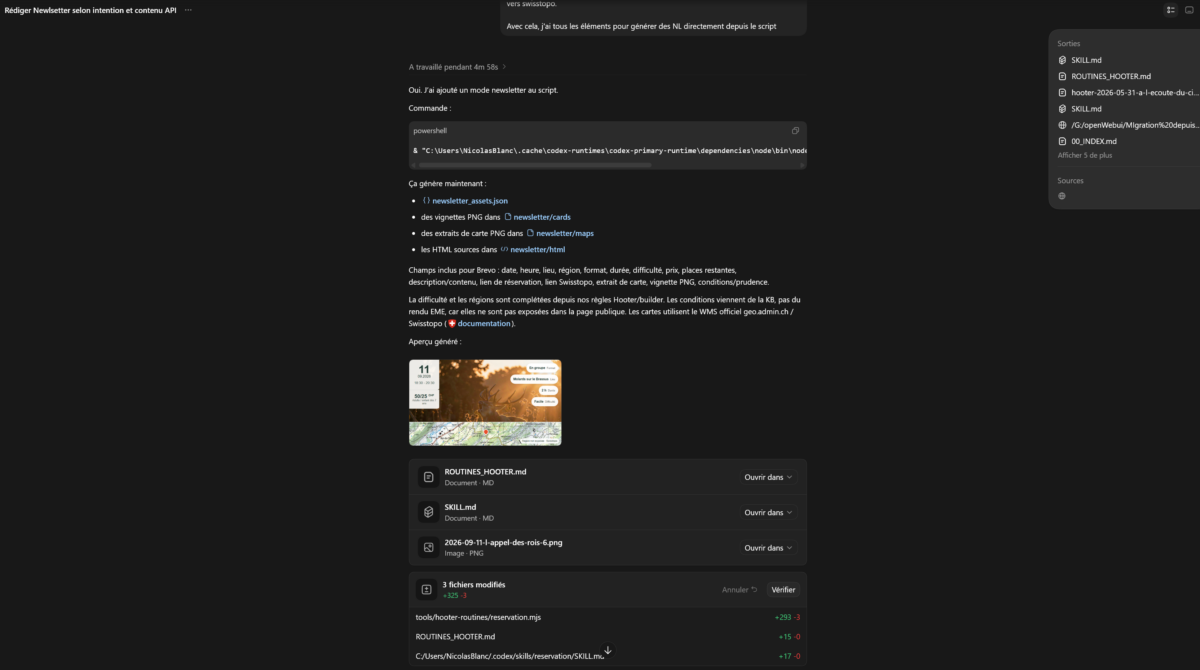
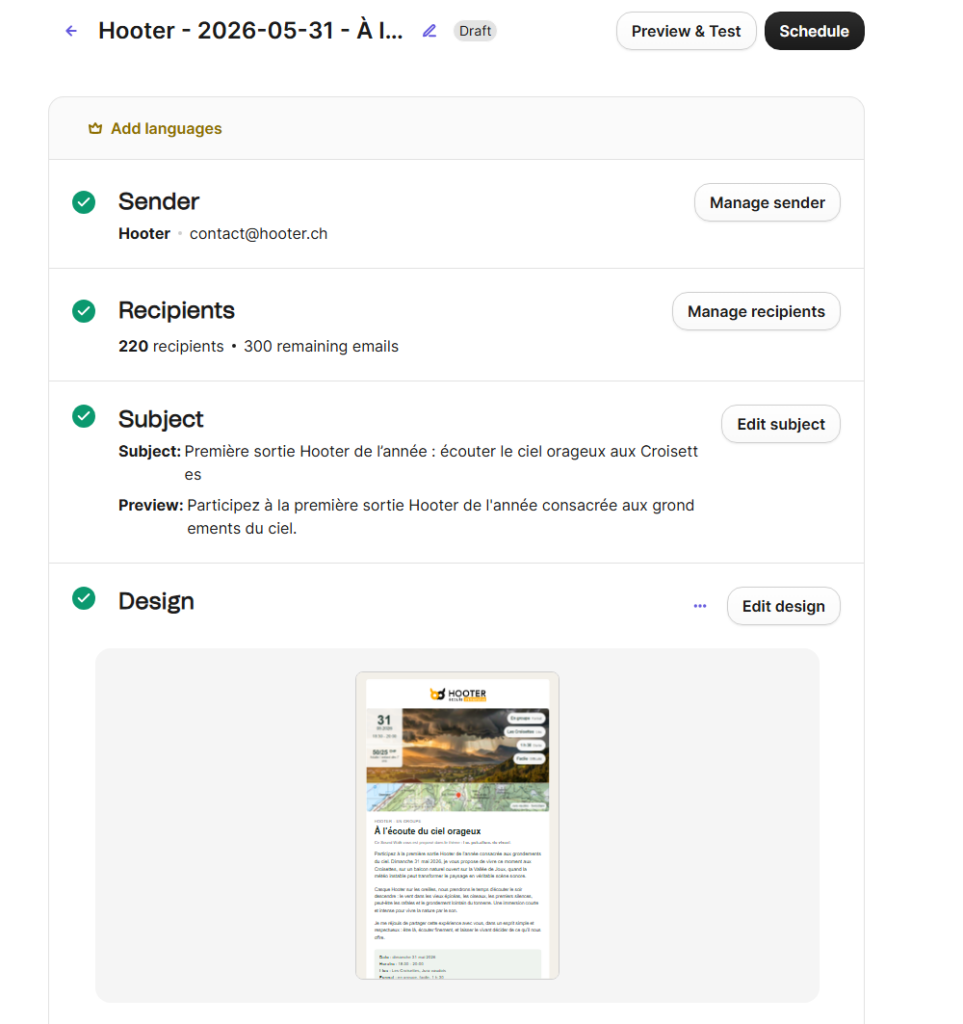
In Hooter, a routine retrieves the public information of an activity, prepares assets for the newsletter, generates thumbnails, maps, HTML, and actionable data. Events Made Easy remains the source of truth for outputs and bookings. Outlook can become a mirror of the calendar. Brevo receives a draft, but the sending remains a human decision.
This point is essential: automation must not erase responsibility. It should prepare what is repeatable, then leave it to humans to verify what matters.
Local Tools for Specific Problems
An AI ecosystem is not limited to large models. It also includes small tools, sometimes highly specialized, created to remove a specific friction point.
For Hooter, field audio files can be heavy, multi-channel, and difficult to prepare quickly. The MixPre ISO Extractor addresses this problem: it extracts the useful tracks from a polyWAV Sound Devices, applies practical settings, prepares separate files, and makes post-production more manageable.
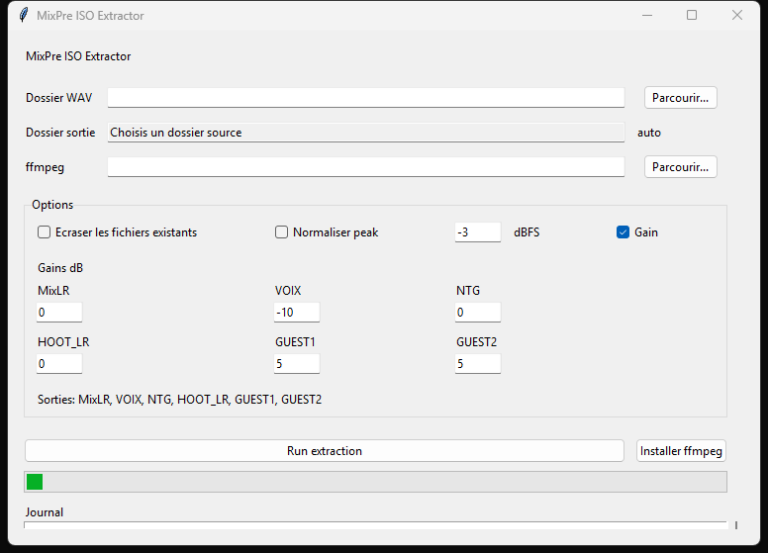
This is not a major software product. It is a business tool. Its value lies in its customization: it knows the Hooter context, the expected tracks, the useful settings, and the repetitive actions to avoid.
The same logic applies to other components: syncing EME to Outlook, preparing a newsletter from an activity, creating an AI skill to turn an article into social drafts, structuring an application, linking WordPress to Polylang and Ollama, or designing a local Social Studio to manage a stock of publications without automatically sending anything.
What This Changes for an SME
For a small business, a small team, or a freelancer, the challenge is very simple: there are too many tasks to do, too little time, and often too much scattered information.
A well-designed AI ecosystem does not promise to replace the company. It allows certain workflows to become more robust:
- information is entered once and used correctly;
- a draft is prepared with the right context;
- a translation follows the tone, categories, and metadata;
- a newsletter is sent from reliable business data;
- an audio or documentation tool removes a repetitive step;
- a process leaves verifiable traces;
- the human validates before sending, publishing, or making a decision.
The promise must remain sober: repeatable, verifiable, workable, correctable. An AI can make mistakes. A system can drift. It is precisely for this reason that it must be designed with limits, control steps, and a true understanding of the business.
A Consulting Method, Not a Collection of Tools
The commercial turning point for Blanc Lab lies here. It is not about selling “AI” in general. It is about helping an organization understand its repetitive tasks, its sensitive data, its existing tools, its friction points, and its lost time margins.
Only then do the technical choices come: cloud model, local model, script, plugin, API, interface, automation, synchronization, or editorial workflow.
This method is based on a few simple questions:
- What takes too much time without creating enough value?
- What is repeated every week, every day, or in every folder?
- Which data must absolutely remain internal?
- Which tools need to learn how to talk to each other?
- Where should the human validate?
- Which task would truly free up time for the core of the business?
The answer is never the same from one company to another. For one, it will be billing and quotes. For another, it will be customer relations. For a third, it will be multi-language publishing. For Hooter, it also includes booking, the calendar, the newsletter, sound capture, field tools, and post-production.
Automating Without Giving Up Control
AI is already useful today, and it will continue to progress. Waiting for it to be perfect makes little sense. The challenge is instead to learn how to integrate it properly: knowing what we give it, what we ask of it, what we keep local, what we verify, and what we refuse to automate.
In this approach, the human does not disappear. They change roles. They stop performing the same manipulations repeatedly and regain time for analysis, creation, relationships, strategy, quality, and important decisions.
A good AI ecosystem does not replace the craft. It protects the time necessary to practice it better.
For Blanc Lab, this is where creative engineering lies today: building useful, interoperable, and controlled systems capable of easing daily management so that businesses can return to what truly matters.