
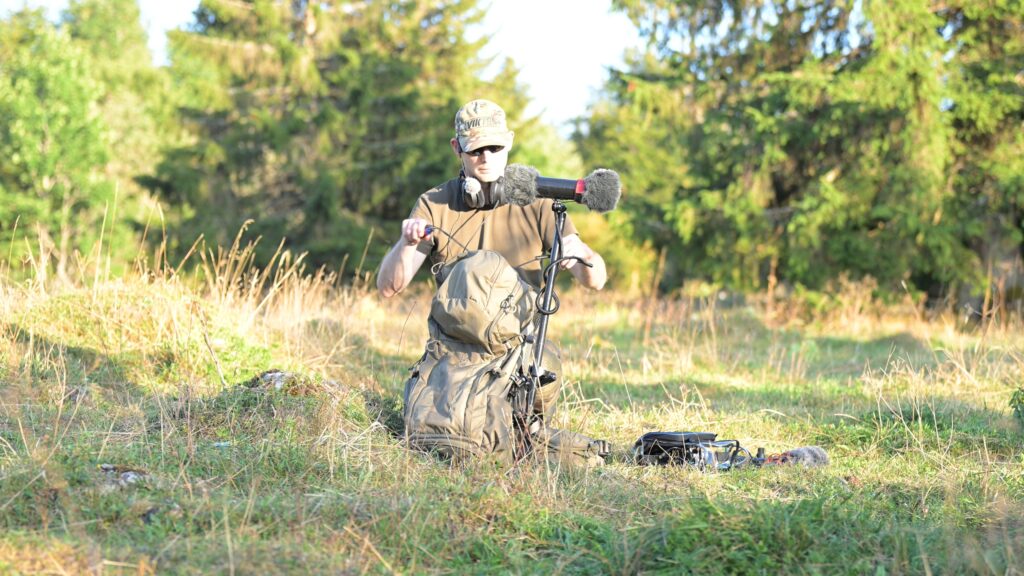
Hooter isn’t just about the capsules. While the first component of the system captures the space, the final fidelity depends on everything that follows: the input, the preamp, the gain, the monitoring, the files, the routing, and the body that carries it all.
In field recording, sound can be lost without any dramatic noise. A cable rubbing against something. A level set too quickly. A headphone output sent too loudly into a distribution system. A flattering but misleading control listen. In the final file, all of these factors become very concrete.
The goal is not just to record a location. The goal is to produce sonic material that already stands on its own.
The chain begins before the record button
The first article on Hooter discussed perception: how to approach a human, spatial, and natural listening experience using a field binaural device. Here, the problem moves up one level. Once this sonic image is captured, how do we preserve it?
The answer isn’t simply “get a good recorder” and move on. The chain must be conceived as a cohesive whole:
- left/right capsules and wind protection;
- robust, lockable, and mechanically silent XLR connectivity;
- clean preamplification capable of respecting faint sounds;
- cautious gain staging for unpredictable events;
- reliable, not just pleasant, headphone monitoring;
- multitrack files usable in editing and post-production.
Ultimately, what matters is continuity. If a single stage degrades the scene, the soundscape may still be pleasant but will lose its precision: less depth, less distance, less clarity.
Preamplification as a field control room
In the Hooter chain, the decisive point isn’t just the recorder. It is the preamplification: the place where a very faint, fragile, sometimes distant signal becomes controllable sonic material without losing its nuance.
In the field, the preamp acts like a small control room. It doesn’t just make the sound louder. It allows you to listen, balance, isolate, equalize, and decide what should take prominence in the moment.
This role becomes essential in a natural scene. A soundscape is not a homogeneous mass. It contains layers: a valley floor, a breath of wind, a nearby presence, a fleeting birdcall, a resonance in the trees, a detail almost lost. The field “control room” allows these layers to be managed as they appear.
The challenge here is less about coldly documenting reality and more about reproducing a credible and impactful soundscape. The chain must preserve the spatial dynamics of the location while allowing live mixing to emphasize certain sounds when the opportunity arises.
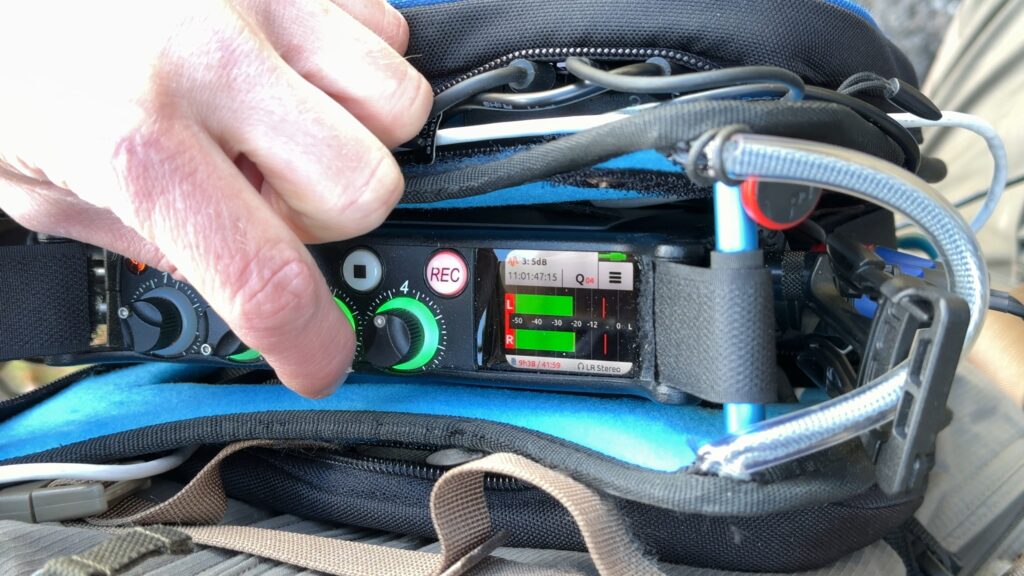
In this logic, the Sound Devices MixPre-6 II remains useful because it combines the necessary functions: high-quality preamps, isolated tracks, stereo mix, monitoring, routing, and usable files. But the object is not the subject. The subject is the ability to transform a field recording into a directed soundscape without breaking the sense of space.
32-bit float provides headroom
32-bit float is invaluable in unpredictable environments. A biome doesn’t give warning before a nearby cry, a gust of wind, a snapping branch, or a sonic event emerging in the middle of a very subtle atmosphere. This dynamic range provides depth for the work ahead.
However, it does not turn the recording into an automatic process.
32-bit float allows for preserving a much wider dynamic range, which can then be made usable through precise track control. It is not a technical “copy-paste.” In the field, you must still listen, adjust, arbitrate, and understand which track carries the useful detail and which others should stay in the background to preserve the scene.
The real question remains the sonic decision. Which signal goes to the listeners? Which layer supports the immersion? Which specific sound deserves to be emphasized? How much headroom must be kept so the scene can still breathe?
In Hooter, this headroom also matters after the take. The system can record a stereo mix and up to six isolated tracks. These tracks provide significant leeway in post-production: working on each microphone, cleaning a layer, reinforcing a presence, shifting a balance, or even reconstructing a soundscape later if the moment could not be fully captured on-site.
The ideal take remains one that stands on its own. But multitracking avoids locking everything into a single decision. It offers a second chance for the soundscape: not to manufacture it artificially, but to recover the scene that the field had begun to reveal.
Three professions in one carrier
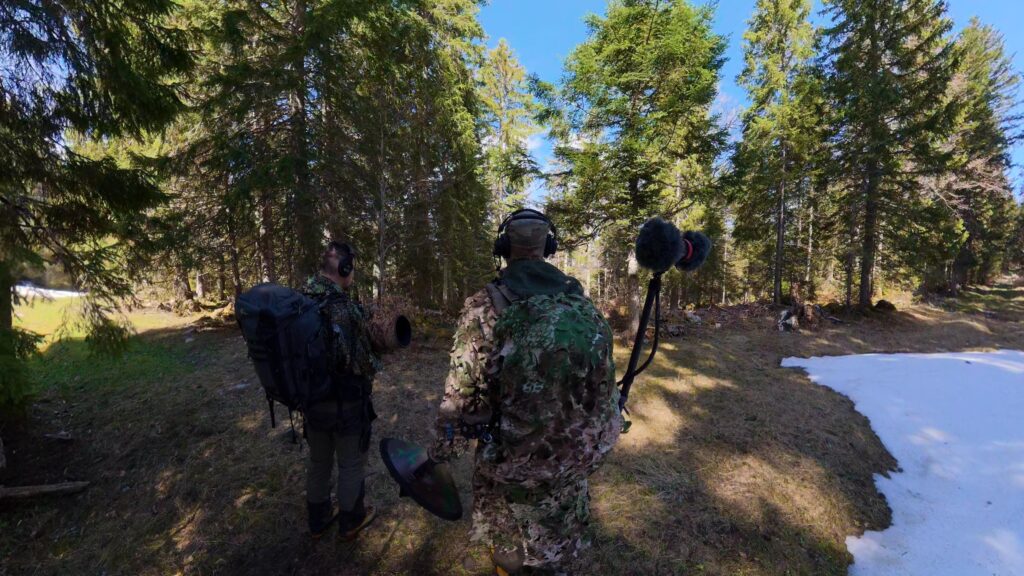
In the field, Hooter condenses several roles into a single gesture. This isn’t just a slogan; it is a production requirement.
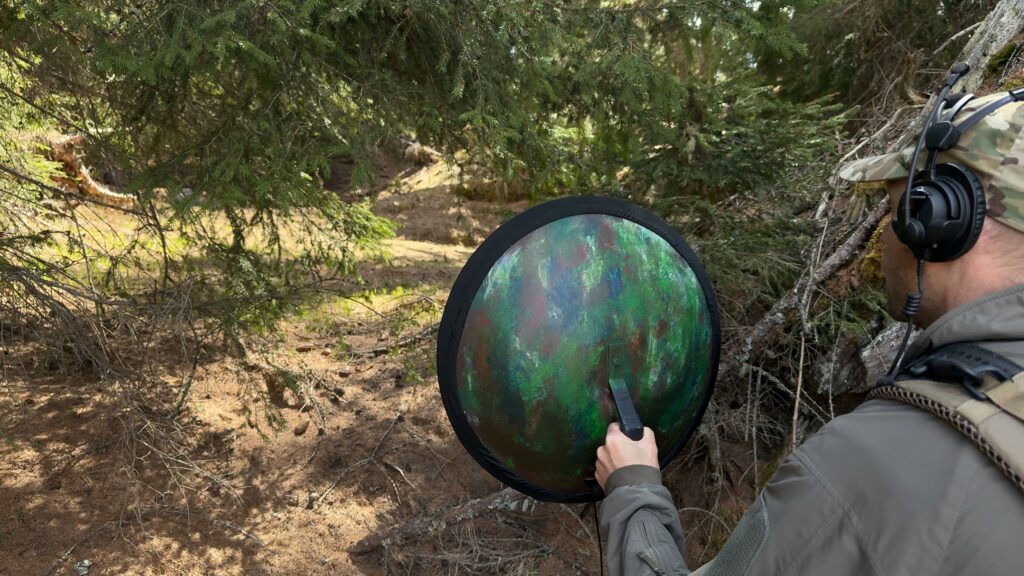
First, there is something of the boom operator: placement, distance, body silence, mastery of friction, and anticipation of movement. Even without a traditional boom pole, the logic remains similar. The system must be present where the listening becomes pure, without the carrier becoming the primary source of noise.
Then there is the sound recordist, or sound engineer: input levels, left/right balance, wind control, headphone monitoring, track selection, markers at the start of a take, and the decision to re-record or not.
And finally, there is the editor / sound designer who thinks ahead. The file must be able to enter a production chain. A poorly named polyphonic WAV, an unidentified track, a mix that is too flattering, or a lack of markers can cost much more later on.
In the field, we don’t just record the present. We also prepare the future of the sound.
What betrays a soundscape most quickly
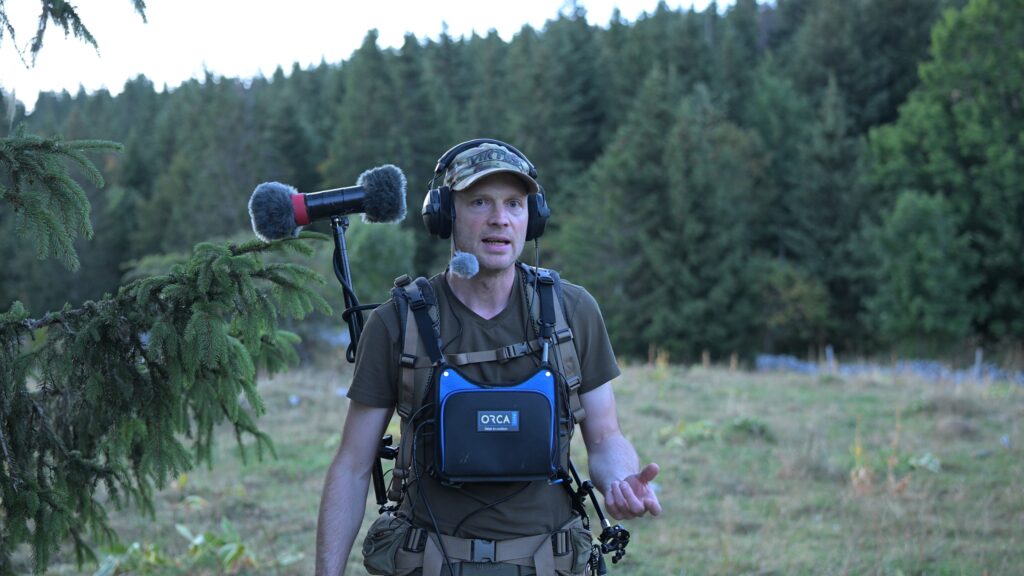
In an immersive recording, errors are not visible. They are heard later, often too late. The most common risks are also the most effective:
- a cable touching a strap and adding a walking rhythm;
- a connector being pulled and producing an intermittent click;
- a wind protection that saves the take but eats too many high frequencies;
- an overly aggressive low-cut that cleans the bass but thins out the location;
- monitoring that is too loud, masking a breath or a vibration;
- an ill-suited output for distribution, which compresses or crushes the dynamics.
In a system like Hooter, these details are not incidental. They determine the presence of the scene. A soundscape can be wide but muddy, spectacular but tiring, clean but flat. The chain must therefore be tuned to preserve what makes the location recognizable: distance, texture, depth, and micro-events.
A take ready for immediate use
The ultimate goal of Hooter is not to produce a take that requires a complete reconstruction in post-production. The target is more demanding: to obtain a spatial, clean, and intelligible soundscape from the moment of capture, with minimal correction required.
This does not mean there is no editing, selection, or processing. It means that the space must already be there. The headphones must recognize the location. The tracks must have enough headroom to work with. The mix must allow for listening without fighting against the technology.
This is where Hooter truly becomes an object of creative engineering. It is not about stacking a microphone, a preamp, a bag, and a pair of headphones. It is about creating a continuity between the field and the file:
- capturing without flattening;
- amplifying without distorting;
- controlling without deforming;
- transporting without adding noise;
- recording without closing off future uses.
The quality of an audio chain is not measured solely by the best component it contains. It is measured at the moment you listen back to the take and almost nothing remains to explain.
The location is there. The sound breathes. The material is ready for production.