
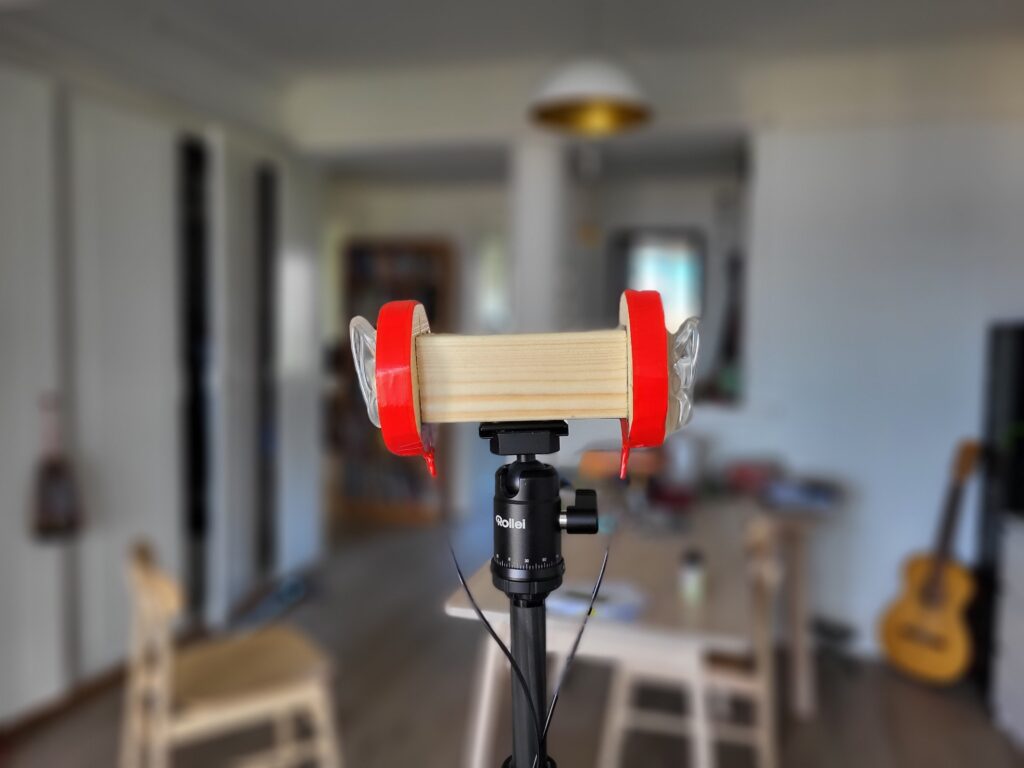
Hooter was born from a seemingly simple acoustic question: how can we capture a soundscape as the human ear perceives it, with enough precision that the recording becomes an immediate and usable piece of material?
Standard stereo provides a left, a right, and a width. Hooter seeks a more complete perception: the way a sound positions itself in space, maintains its distance, its relief, and its texture, eventually reaching the headphones with that very specific impression of actually being in that place.
The idea lies in a single vision: creating a “field ear.” An ear more robust than our own, easier to connect to a professional chain, capable of capturing extremely subtle sounds as well as much more powerful sources, and above all, producing an exploitable soundscape without the need for reconstruction later.
Why standard microphones aren’t always enough
Standard microphones are excellent when you already know exactly what you want to isolate. A highly directional mic targets a source. A stereo pair opens up a scene. An ORTF, NOS, or XY system provides a coherent image for music, documentaries, or atmosphere.
But in the field, the problem changes. You aren’t just capturing a source. You are capturing a place.
A biotope, a street, a forest, a storm, a crowd, a film set, or a documentary scene does not fit into a single primary sound. They live in layers: distances, reflections, faint details, movements, accidents, and small events that are almost invisible. This is where immersion begins.
In a world where imagery is becoming immersive—with 360-degree video, headphone experiences, mediation devices, and enriched live broadcasting—sound must follow the same movement. It no longer serves merely to accompany the image; it carries the location.
Starting from the biological tool
The human ear doesn’t just measure a sound level. It constantly compares what reaches both sides of the head: differences in timing, intensity, subtle variations in timbre, and the effects of the pinna, the auditory canal, skin, cartilage, and the shape of the skull.
These tiny discrepancies allow the brain to locate a sound. A rustle might be to the left, but also close, far away, in front, slightly behind, sharp, diffused, masked by a background, or conversely, isolated in space.
The work on Hooter stems from this observation: before choosing a capsule or a cable, one must understand how our own auditory system constructs space.
Reproducing an ear, not just holding two microphones
The Hooter prototype goes beyond the simple placement of two capsules side-by-side. It seeks to reconstruct a logic of listening.
Shapes close to the ear, work around the auditory canal, and the use of soft materials like silicone all point in this direction. Silicone is used for its acoustic behavior: closer to a soft fabric than a hard surface, it absorbs, transmits, and filters differently than rigid plastic or metal parts.
This work creates a functional ear. Not a medical copy, but rather an acoustic interface that gives the capsules cues closer to those received by our own auditory system.
Turning intuition into a measurable prototype
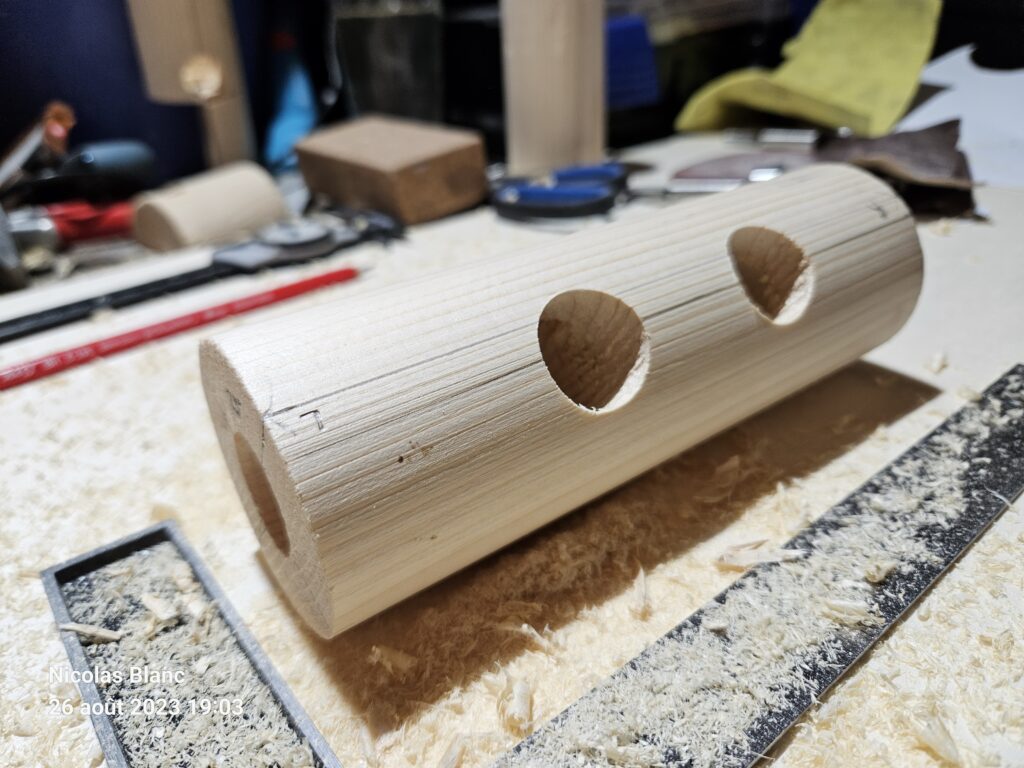
The manufacturing photos tell this story in very concrete terms. A piece of wood is measured, drilled, and adjusted. The two sides are physically separated. The prototype must be precise enough to create a stable image, but robust enough to leave the lab and function outdoors.
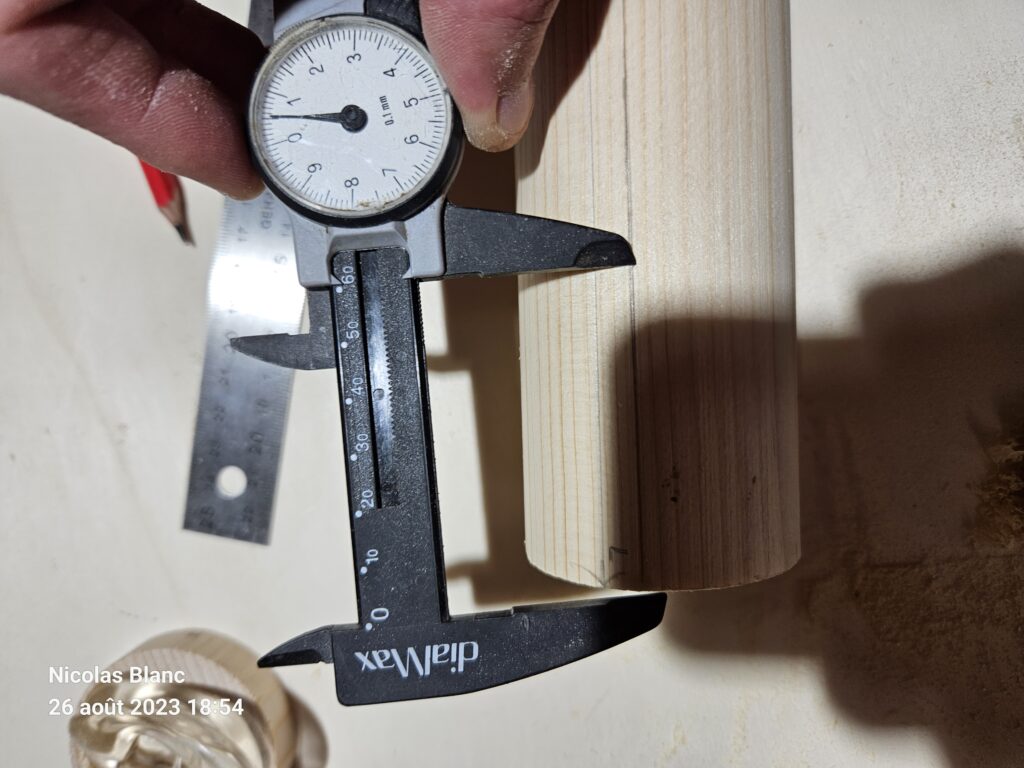
Here, every decision matters: the distance between capsules, left/right symmetry, the volume of the support, orientation, mechanical stability, and protection against handling. The right result stems from a compromise between geometry, materials, capsules, protection, and real-world use.
The question becomes very practical: where to place the capsule so that the location remains legible? At what point does separation help the brain? When does wind protection begin to eat away at the detail? In Hooter, design is judged by listening.
The role of the acoustic baffle
The support placed between the two sides also serves as an acoustic baffle.
The term can be misleading: in this context, a baffle refers to a physical form placed between two capture zones to create an acoustic shadow. Much like the head between our two ears, it ensures that the signal received on the left differs slightly from the one received on the right.
This separation provides the brain with additional information to reconstruct space. It reinforces the difference between the two channels with a guiding principle: making the scene more legible, deeper, and more natural, without turning the recording into a sonic effect.
Capsules chosen for faint sounds
The final quality also depends on the capsules. Hooter relies on omnidirectional capsules with very low self-noise, such as the Primo EM272Z1 or equivalent depending on the setup. Their advantage is clear for nature and field work: they capture the atmosphere, the ambient field, faint sounds, and micro-variations without imposing a heavy directional bias.
The figures illustrate the scale of this technical choice:
- frequency response: 20 Hz to 20 kHz, covering the essential range of human hearing;
- sensitivity: -28 dB, with a tolerance of approximately ±3 dB at 1 kHz;
- signal-to-noise ratio: 80 dB;
- self-noise: approximately 14 dBA, very low for this type of capsule;
- maximum allowable level: approximately 119 to 122 dB SPL depending on the version and setup.
In short, the system must be able to capture extremely subtle sounds, such as a rustling leaf, an insect, a distant breath, or a small movement in the vegetation. But it also maintains enough headroom for much stronger sources: a nearby waterfall, a storm, an engine, or a dense urban environment.
These characteristics never work in isolation. The entire chain must be coherent: capsule, power supply, cable, preamp, gain, and recording. When everything is aligned, Hooter can produce a clean take across a wide range of situations, from fragile details to dense sound environments.
Professional connectivity
The finished system must also be able to integrate into a serious audio chain. The use of XLR connectors, the standard for professional sound, serves this purpose.
Behind the XLR format lies robust, lockable connectivity designed for the field and compatible with professional preamplifiers, recorders, and audio interfaces. It allows Hooter to be integrated into a clean capture chain: high-quality preamp, appropriate power supply, gain control, headphone monitoring, and multi-track recording.
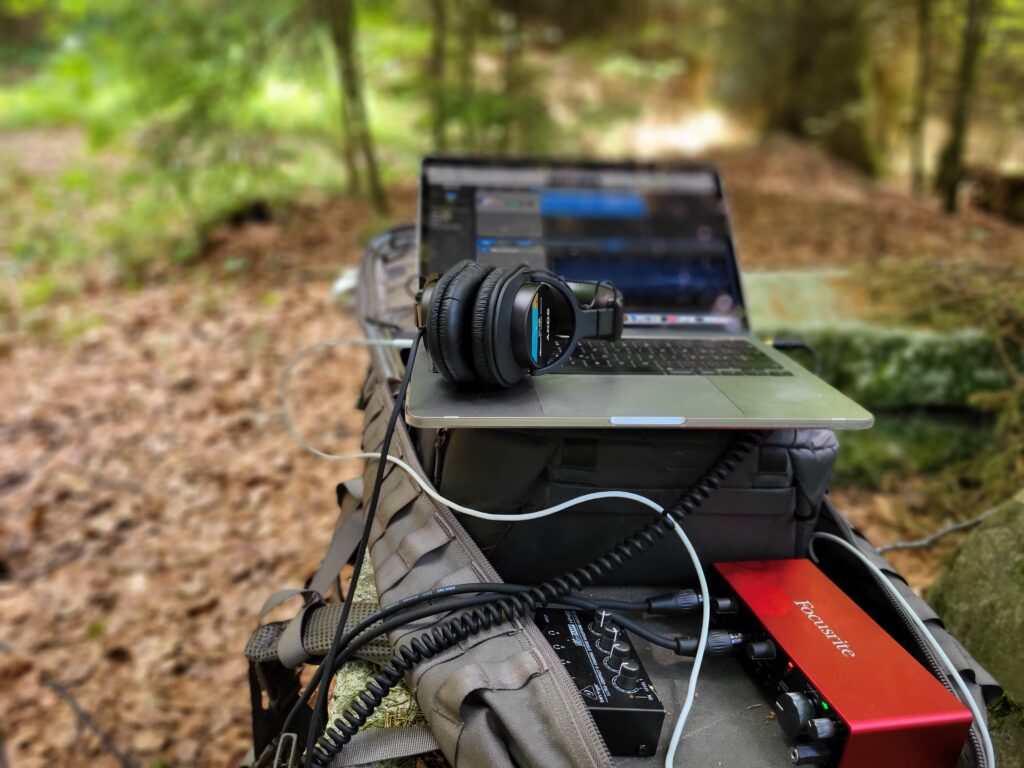
This compatibility changes the nature of the object. Hooter becomes a capture source integrable into a production workflow: preamplifier, routing, monitoring, recording, headphone distribution, video, synchronization, and post-production if necessary.
Technical neighbors, clear direction
To understand Hooter, known techniques serve as reference points.
- ORTF: two cardioid microphones spaced and oriented to produce a natural stereo image.
- Classic Binaural: a real or artificial head to replicate the cues of human listening.
- Jecklin Disc and baffle systems: a physical separation between two microphones to create a more legible left/right difference.
Hooter moves within this technical neighborhood, with a very practical direction: creating a field tool capable of recording a sound scene with highly accurate spatial perception, regardless of the source.
Biotope, animal, landscape, weather event, urban setting, documentary scene: the system must remain legible even when the sonic world becomes complex.
Reference serves less as a checklist and more as a point of support. It is the use case that decides: reproducing human auditory perception with an enhanced capture capability.
Uses beyond nature
Nature was the most demanding testing ground because it combines many constraints: faint sounds, wind, humidity, movement, long waits, and unpredictable events. This demanding terrain forged a system usable elsewhere.
Field binaural spatial capture can interest several applications:
- soundscapes, sonic landscapes, and biotope archives;
- documentary and cinema, when a scene needs to feel more embodied;
- 360-degree video and immersive headphone experiences;
- immersive live broadcast, events, or performance capture;
- audio mediation for museums, public paths, or installations;
- training, demonstration, research, and analysis of sound environments;
- sound design and the creation of realistic atmospheres.
In all these cases, the goal is simple: obtain a usable, intelligible soundscape that can be used in production with minimal correction. When the source is good, the recording should already contain the space.
Fidelity as an engineering compromise
Fidelity is not just about a frequency curve. It lies in a more delicate balance.
It means keeping faint sounds without adding hiss. Protecting against wind without muffling high frequencies. Separating the two sides without making the listening experience feel artificial. Amplifying without hardening. Providing width without losing the center. Creating presence without masking reality.
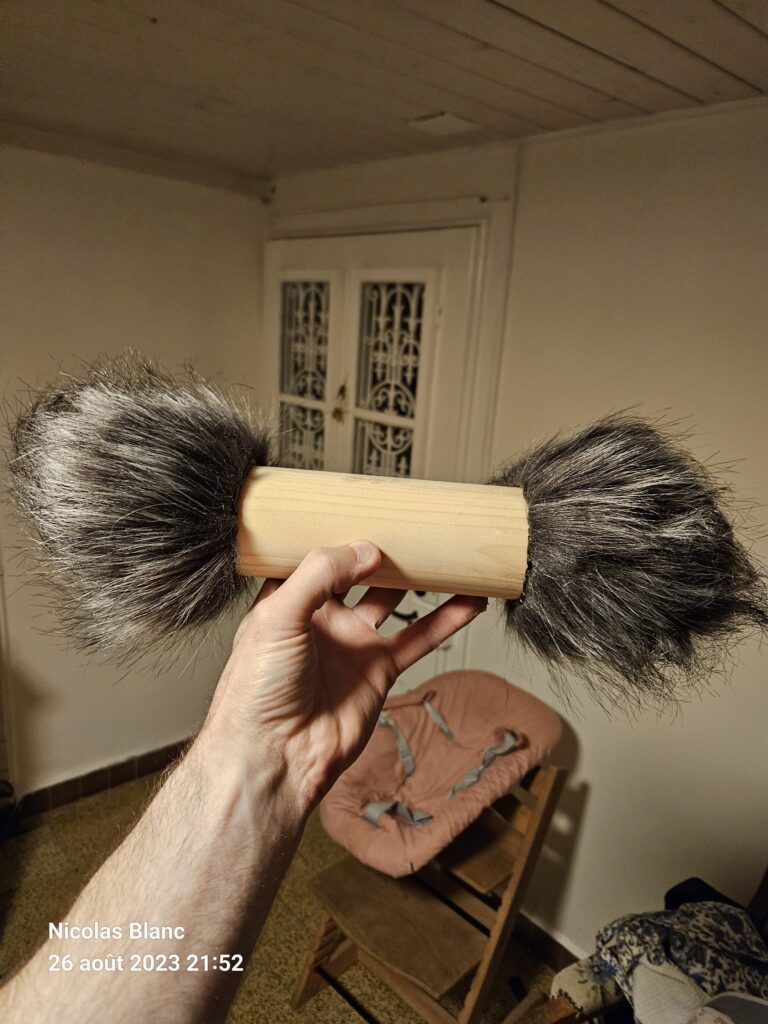
Wind protection clearly illustrates this compromise. They are essential outdoors, but they can alter timbre, highs, left/right balance, and handling noise. In a field binaural system, an accessory is never neutral: it becomes part of the acoustics.
A specialized capture tool
The strength of Hooter lies in this combination: a logic inspired by the human ear, a binaural architecture, work on the acoustic baffle, soft materials close to the behavior of an ear, low-noise capsules, professional connectivity, and integration into a complete audio chain.
The target is professional: obtaining a usable soundscape straight out of the preamplifier. Clean, spatial, intelligible. If the source is good and the recording is correctly set up, the sound should be usable with minimal post-processing.
Hooter seeks to create a field ear: subtle enough to capture quiet sounds, robust enough to handle powerful sources, spatial enough to convey the presence of the location, and reliable enough to enter a real production chain.
When the source is good, the recording should already contain the space.
This is the point that matters in the end: plug in, set up, listen, and not have to reconstruct the location afterward.
See Hooter in action
Hooter also exists through experiences and concrete applications: live listening in nature, immersive capture, high-definition recording, broadcast, or 360° content.
The website hooter.ch presents the general approach, the experiences built around the system, and how listening becomes a field of exploration.
For professional uses, see the Hooter applications or get in touch via hooter.ch/contact.