

An activity published on a website, an offer updated in a CRM, or an event added to a booking tool do not automatically become effective communication. Between the business data and the public message, a bridge is often missing.
In many organizations, the problem isn’t just producing content. The real friction lies between the tools: an event exists in a booking system, an offer is updated in a CRM, a product page changes on a website, and then someone must transform all of this into a public message.
The gain, therefore, is not just about going faster. It consists of connecting the right tools without losing human intent.
This point is crucial because useful automation does not begin with technology. It begins with a business perspective: understanding what each tool can already do, what it exposes, what it leaves out, and where humans must still make the decisions.
Business information, multiple uses
The Hooter case starts from a simple situation: an outing dedicated to listening to stormy skies is created in the site’s business tool. The activity already contains much useful information: date, time, location, price, difficulty, description, booking link, and visual elements.
The method involves not viewing WordPress, Events Made Easy, Swisstopo, Brevo, or Codex as isolated blocks. Each has its own logic. WordPress publishes, Events Made Easy structures the activity, Swisstopo locates the field, the newsletter tool distributes, and Codex orchestrates and reformulates. The work consists of understanding these roles and then designing the passages between them.
A routine powered by Codex then retrieves the available elements, verifies them, and transforms them into communication assets. It does not function as a simple text generator. It acts as an intermediary layer between the business tool and the distribution tool.
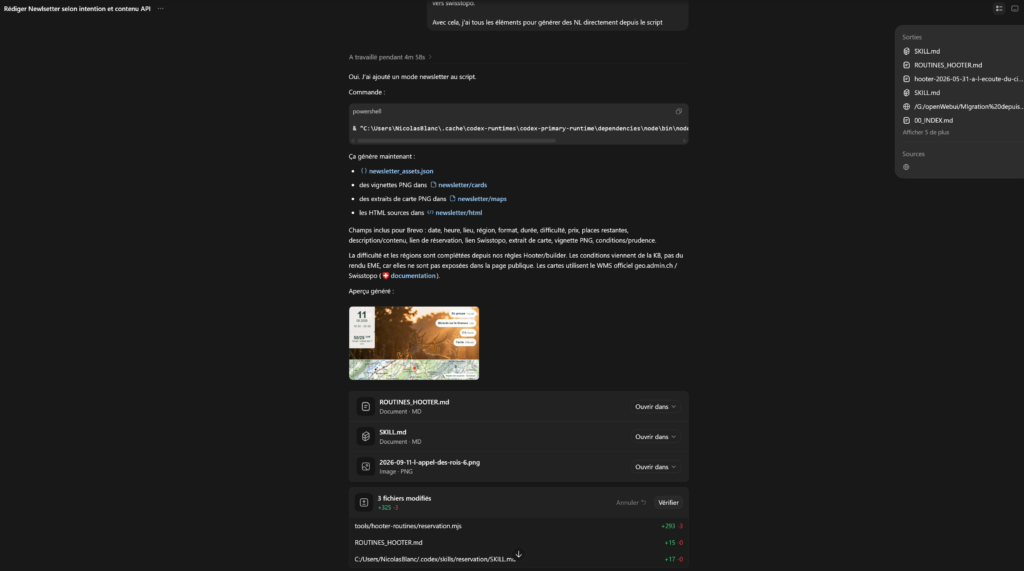
Codex prepares the useful elements for distribution here: structured data, thumbnails, maps, visuals, and fields intended for the newsletter tool.
The decisive role of the angle
The interesting part arrives when the routine requires an editorial intent. In this specific case, the chosen angle was the start of the season: inviting the public to participate in a first immersive listening experience related to storms.
This step changes the nature of the automation. It is not about letting a machine speak on behalf of the organization, but about giving it a framework: what message, for which audience, with what promise?
Based on this intent, the system prepares the subject line, the preheader, the body text, the practical information, the visuals, and the link to the booking. The newsletter tool can be Brevo, Mailchimp, a CRM, or another platform. The principle remains the same: connecting a business tool to a communication tool.
What remains human
The system can assemble data and produce a solid draft. It does not replace judgment: choosing the promise, sensing the right moment, deciding on the audience, and approving the send remain editorial acts.
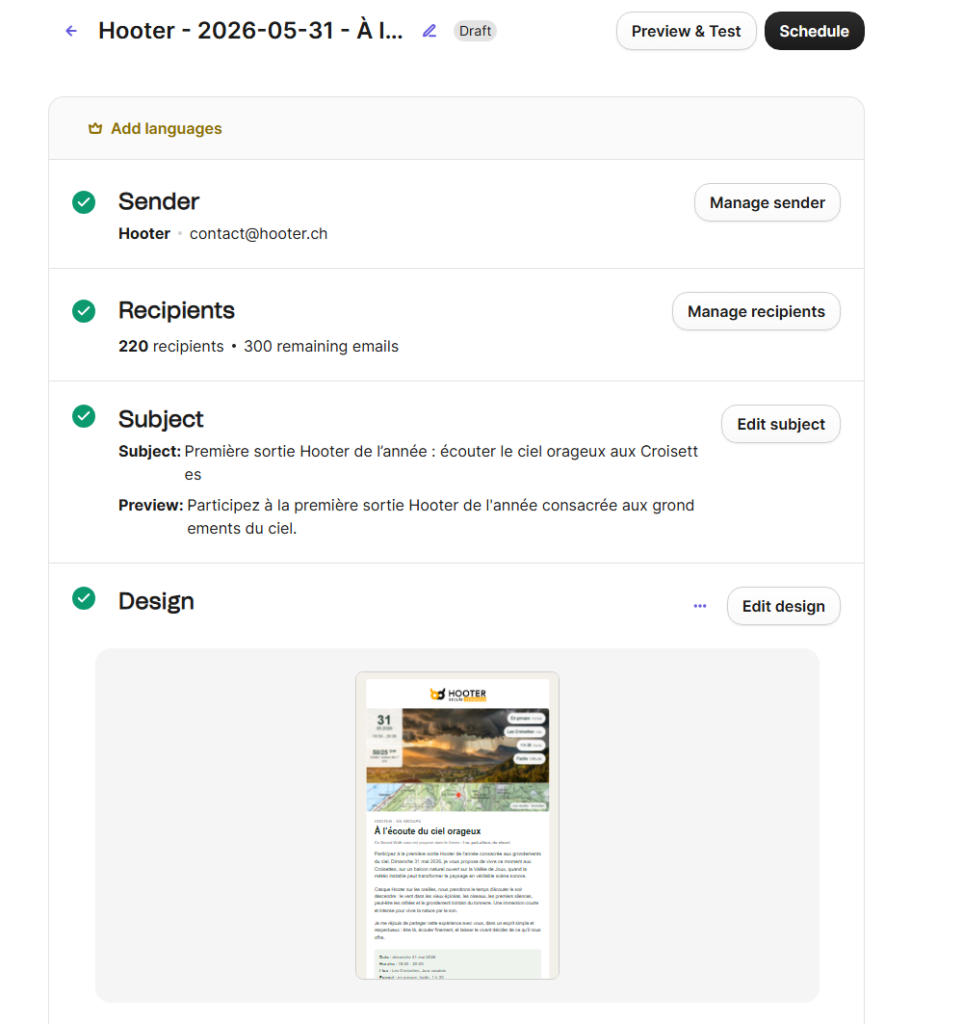
In the distribution tool, the campaign is prepared with the sender, the audience, the subject, the preheader, and the design. The final send remains a human decision.
Five steps, not a recipe
The goal is not to publish a technical recipe to be copied exactly as it is. What matters is the design logic. In this prototype, it consists of five movements:
1. Identify the business need: transform an activity published on Hooter into a ready-to-read newsletter communication. 2. Create a reusable routine capable of fetching data, verifying the activity, generating assets, and preparing the campaign. 3. Link the sources: WordPress, Events Made Easy, location information, price, availability, links, and descriptions. 4. Add the human editorial layer by requesting the intent or angle before generating the final text. 5. Produce an actionable output: thumbnail, map, HTML, campaign data, newsletter draft, and evidence submitted to Blanc Lab.
This workflow can be applied to other contexts: announcing an event, re-engaging a community, promoting an offer, documenting a project, or preparing a campaign based on data already present within the organization.
The value is not in the names of the tools, but in how you make them cooperate.
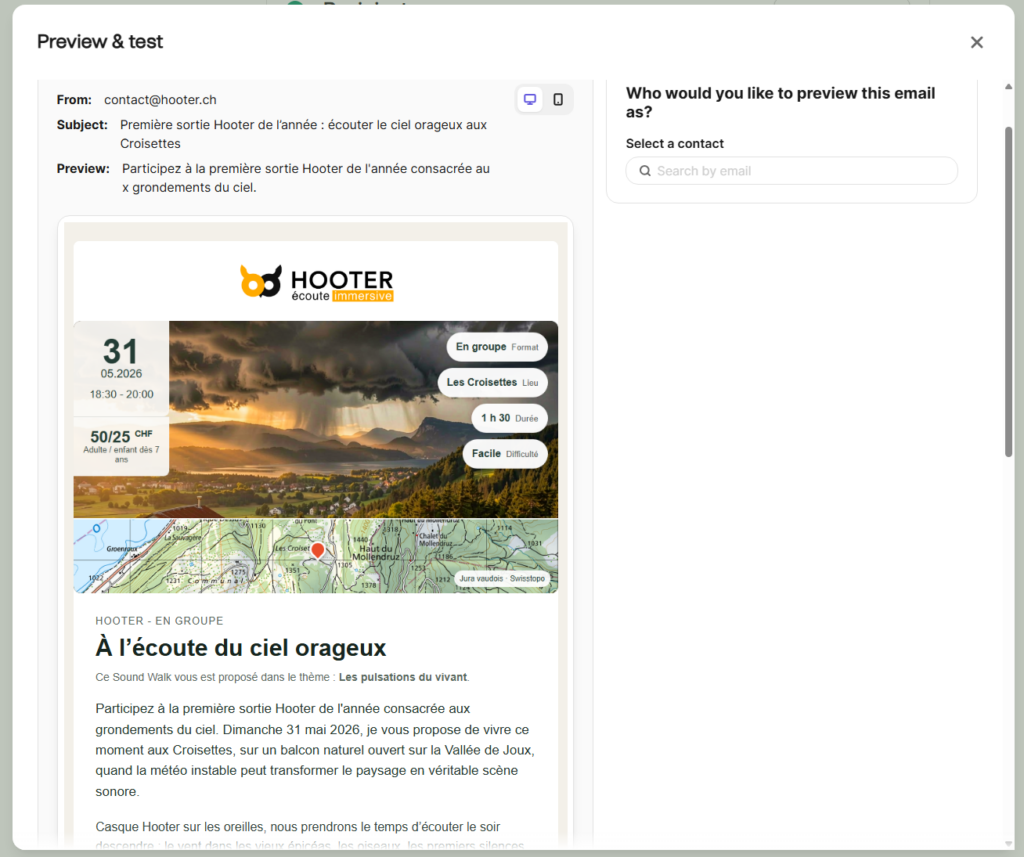
The preview allows for checking the final rendering before sending: content, visuals, booking link, and editorial consistency. In this example, the link might currently lead to an inactive page because the documented activity has passed.
Keeping humans in the loop
The first challenge was not automating blindly. For a real activity, it is necessary to verify dates, remaining spots, prices, and booking links before communicating. A well-written newsletter based on false information remains poor communication.
The second challenge was connecting tools that do not naturally speak to each other. WordPress, Events Made Easy, Swisstopo, visual generation, the newsletter tool, and Codex were not designed as a single system. This is precisely where creative engineering comes in: observing use cases, understanding formats, and then building the necessary bridges.
The third challenge was finding the right balance between automation and human control. The point of this type of system is not to eliminate communication work. On the contrary, it shifts the effort toward what has the most value: choosing the angle, verifying relevance, adjusting the tone, selecting the audience, and deciding on the timing of the broadcast.
For a professional, this can transform a chain of copy-pasting into a more fluid editorial process. Instead of reconstructing the same information multiple times, the team can focus its energy on the quality of the message and the consistency of its online presence.
For Blanc Lab, this prototype illustrates a very concrete digital transformation: designing bespoke digital skills capable of linking field practice, tools, and communication without removing the human element that gives the message its value.