

A professional career can have many faces. Depending on the offer, the recruiter, the sector, or the level of responsibility, the same experiences do not tell exactly the same story.
Many candidates believe they are tailoring their CV by changing a title, a few keywords, and the order of some skills. This is sometimes useful. However, to land an interview, the work begins much earlier: in reading the offer, understanding the employer’s needs, and selecting the evidence that sparks interest.
The context makes this issue particularly sensitive. The job market is competitive, searching for a position puts significant pressure on candidates, and AI is already integrating into both recruitment tools and application tools. JobCloud, which includes platforms like jobs.ch and jobup.ch, documents the use of AI for offer recommendations, certain application texts, and matching functions between profiles and advertisements: JobCloud AI usage guide.
In the face of this automation, the risk is not just that machines will sort applications. The risk is also that candidates will produce identical responses: clean CVs and correct cover letters that are too vague, too standardized, and poorly connected to a real story.
To test this idea, Blanc Lab took a job offer as an example and built a fictional application based on a real profile. The goal was not to expose a specific candidacy, but to demonstrate what applied AI can achieve when guided by HR methodology, editorial skills, and a base of professional resources.
A CV is not just a document
A CV is often presented as a summary page. In reality, it is more of an interface: between a career path, a job offer, a recruiter, HR criteria, and concrete evidence.
The problem becomes clear when a profile is rich or hybrid. Should you show everything at the risk of overwhelming the reader? Or should you simplify drastically at the risk of erasing what makes the candidate valuable? This prototype starts from that tension: a good tailored CV must not say everything. It must choose.
A targeted CV doesn’t say less. It says more clearly what matters for this specific meeting.
In this logic, the full CV does not serve as the document to be sent directly. Instead, it becomes an internal database from which the system can pull:
- verifiable experiences and achievements;
- skills relevant to the offer;
- tools, methods, and technical resources;
- training and career milestones;
- transferable assets and concrete examples.
The system then selects what truly responds to a specific offer.
This is where the difference with a general-purpose tool lies. An AI can write a letter in seconds. But if it knows neither the career path, nor the nuances, nor the ambitions, nor the available evidence, it risks producing an acceptable but interchangeable application. The method tested here starts from a central AI—already used in other projects—enriched by personal resources and specialized skills.
Reading the offer as a specification sheet
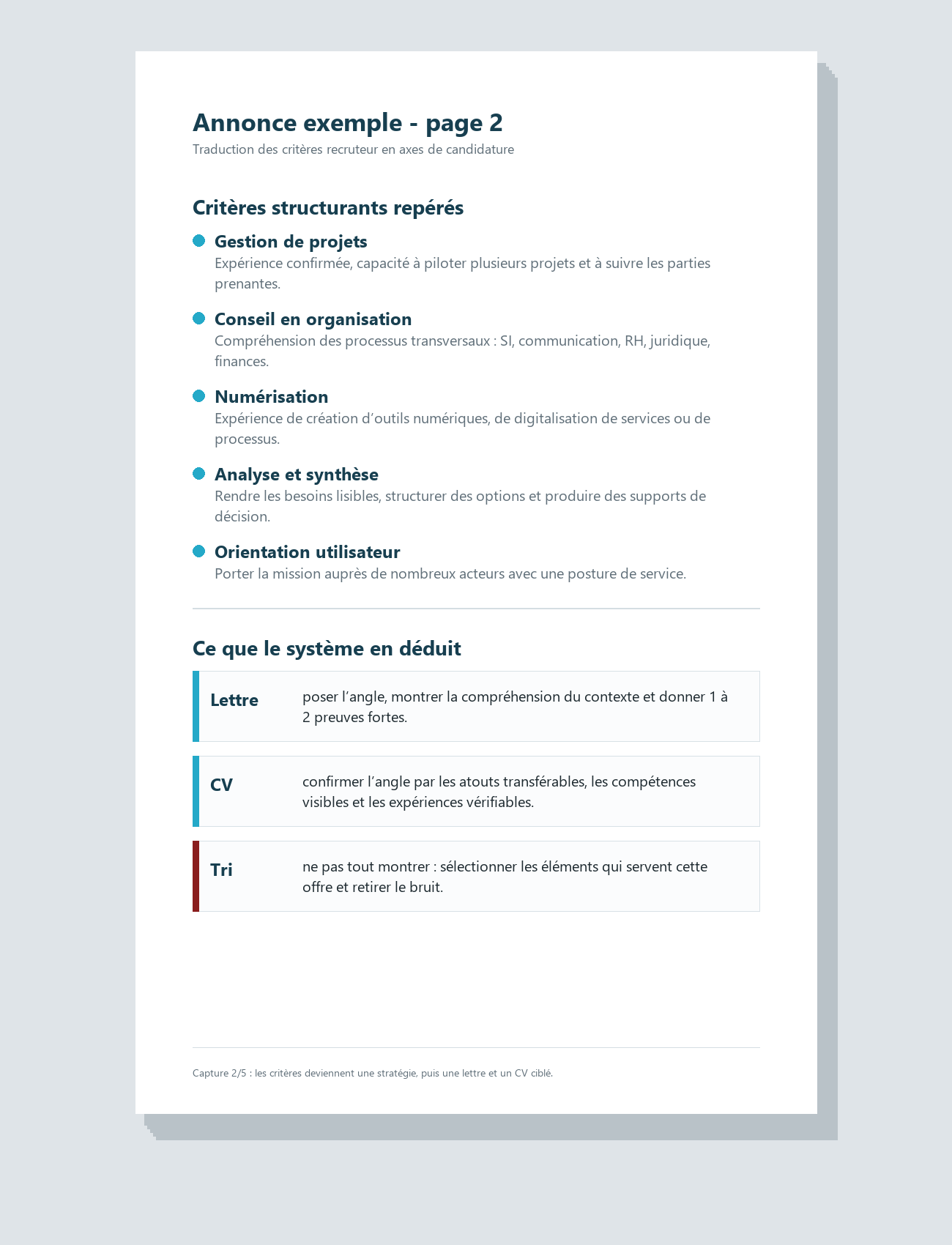
Before generating anything, the announcement is analyzed as a set of specifications. We specifically look for:
- actual missions and responsibilities;
- mandatory and desired criteria;
- HR keywords;
- expected level of responsibility;
- potential points of confusion;
- evidence to be highlighted in the file.
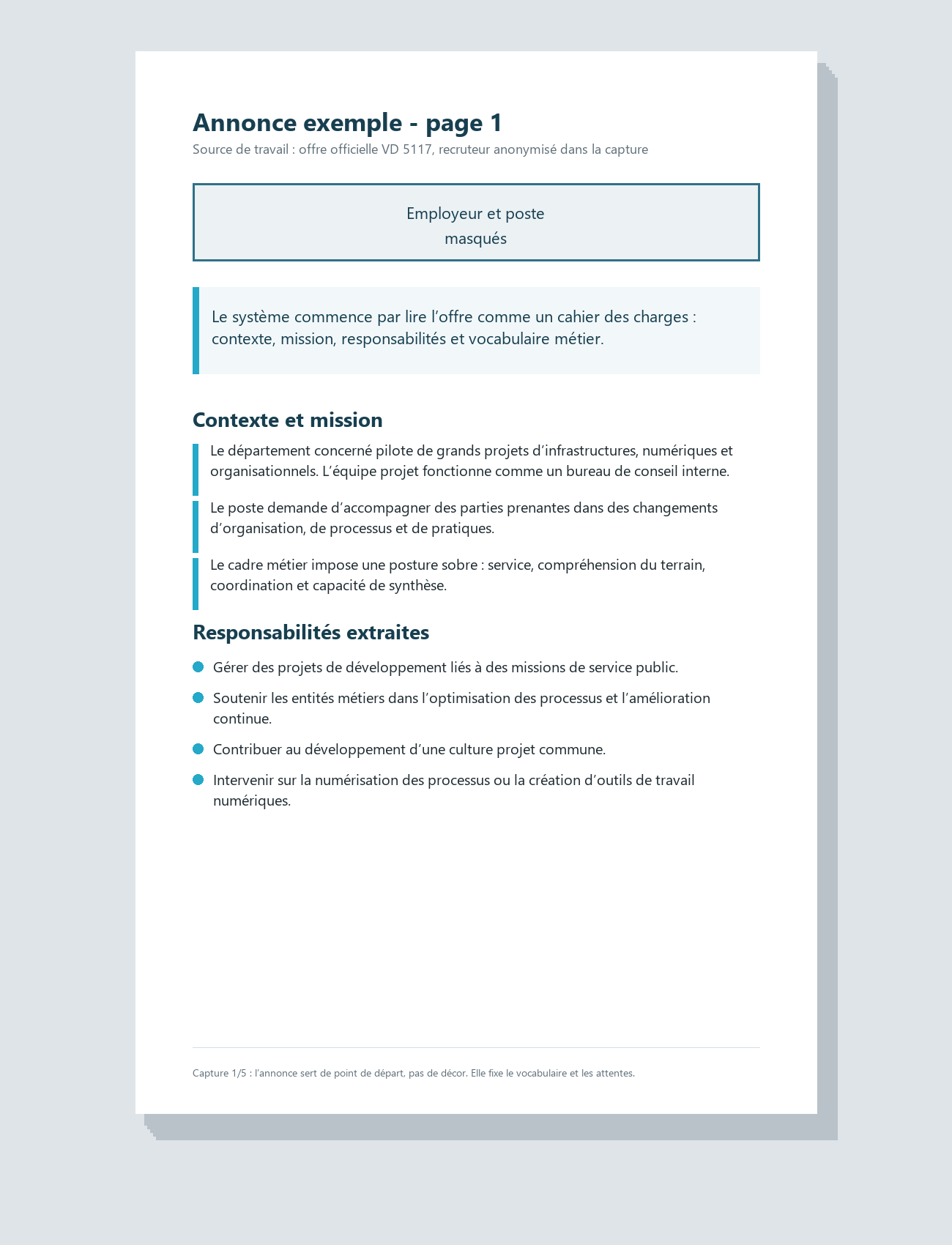
In this simulation, the starting point is a public offer from the State of Vaud’s employment portal, used as a working example. The goal is not to publish an application, but to show how a real announcement can become a selection grid for a tailored cover letter and CV.
The employer’s context matters as much as the list of tasks: mission, environment, culture, constraints, vocabulary, institutional tone, digital maturity, and target audiences. A targeted application must give the impression that the candidate understands the field in which they wish to enter.
This is where the employment coach becomes essential. Their role is not to make the CV “prettier,” but to set the angle of the application: which axes to highlight, which examples to keep, which details to trim, which words to avoid, and what posture to adopt toward the recruiter.
In this prototype, this role is fulfilled by an HR skill: an employment coach trained to read an announcement, understand application codes, identify implicit criteria, and transform a career path into professional arguments. It works with a writing skill, followed by the perspective of an editor-in-chief: the first seeks HR accuracy, the second builds the phrasing, and the third verifies the angle, readability, and overall coherence.
Transforming a career path into resources
Once the offer is understood, the professional journey is treated as a resource base. The same experience can, for example, be used to demonstrate:
- project management capabilities;
- the practice of digitizing processes;
- coordination between management, users, and service providers;
- institutional communication skills;
- tool literacy: CRM, audiovisual, automation, documentation, or support.
The system does not seek to manufacture an artificial profile. It links real elements to the needs stated in the announcement. A highlighted skill must be traceable back to a specific experience. Evidence cited in the letter must be visible in the CV. A named tool must serve the understanding of the role, not simply decorate a list.
It is also a way to respect HR codes: speak clearly, remain sober, avoid overselling, and frame skills as answers to the employer’s problems.
The letter and the CV must tell the same story
A common mistake is treating the CV and the cover letter as two separate documents. The prototype treats them as two complementary pieces.
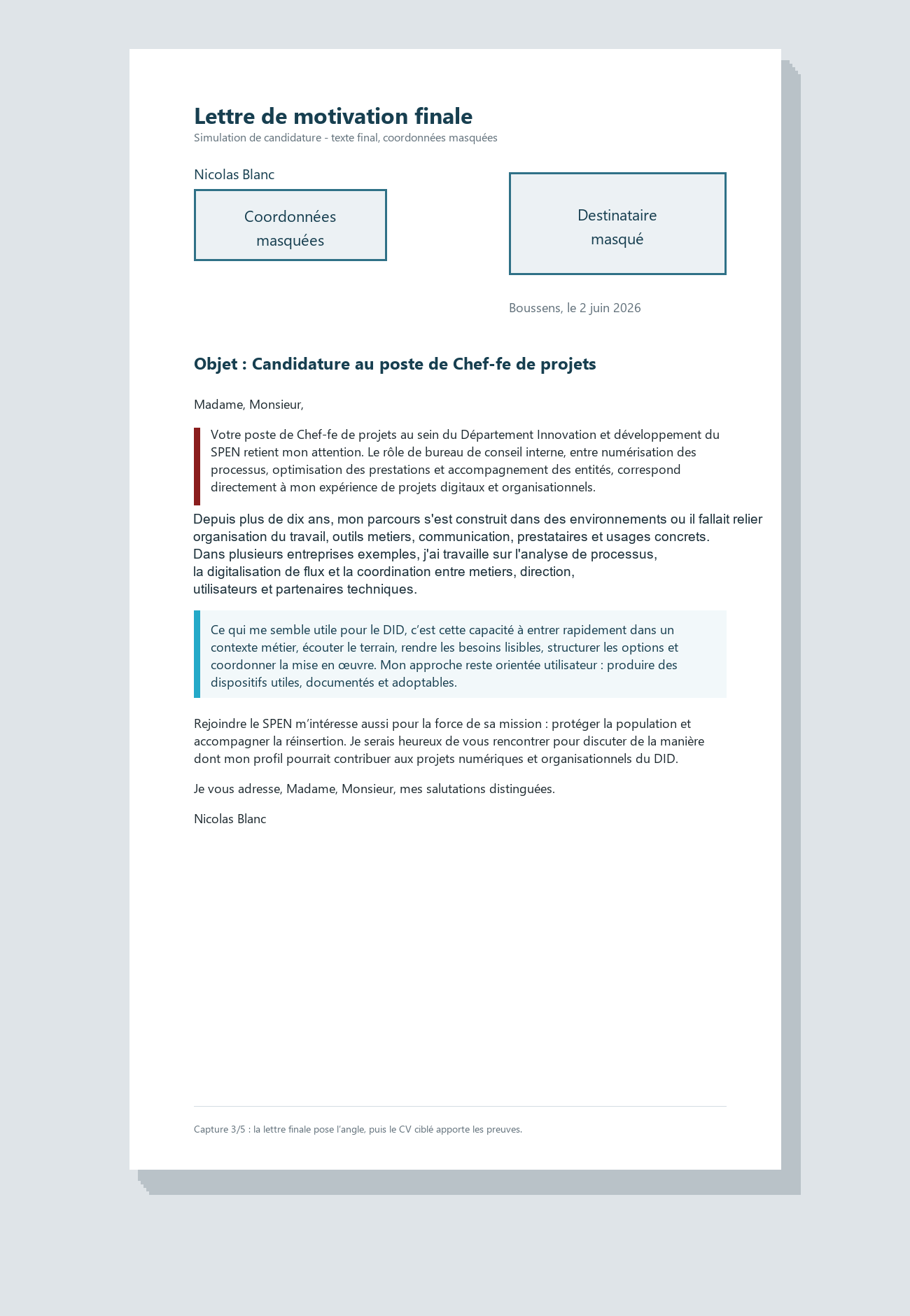
The letter opens the reading: it sets the angle, shows an understanding of the context, and provides one or two strong pieces of evidence. It should not repeat the CV. Instead, it must explain why this specific career path deserves to be viewed through this particular lens.
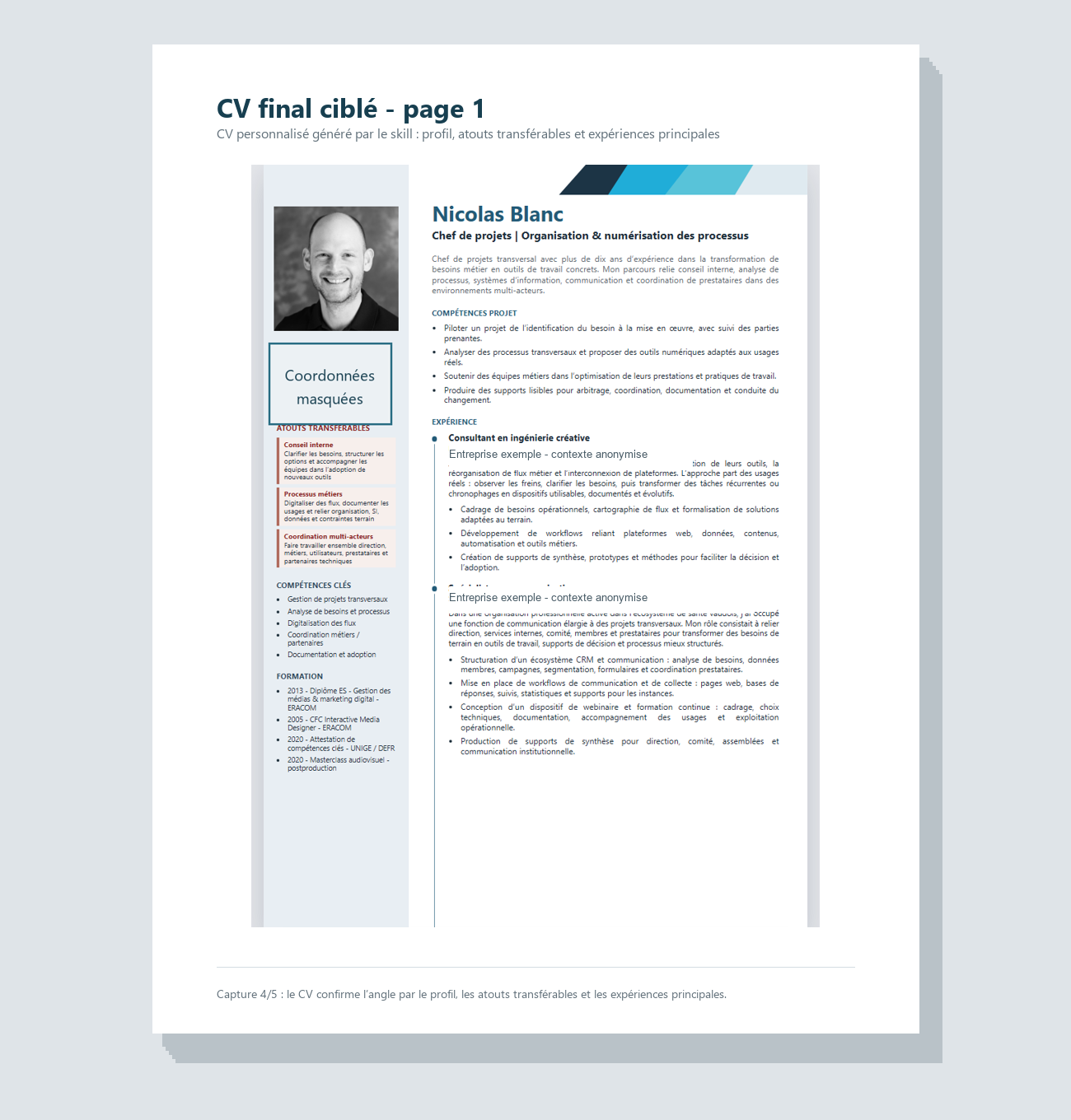
The CV then confirms this promise: it structures skills, transferable assets, experiences, and technical resources in a more verifiable way. If the letter speaks of process transformation, the CV must show where that skill was exercised. If the CV highlights coordination between management, users, and providers, the letter should be able to rely on that same logic.
The announcement provides expectations, the letter provides meaning, and the CV provides evidence.
The dossier then becomes coherent instead of looking like a collection of generated texts.
The full journey in images
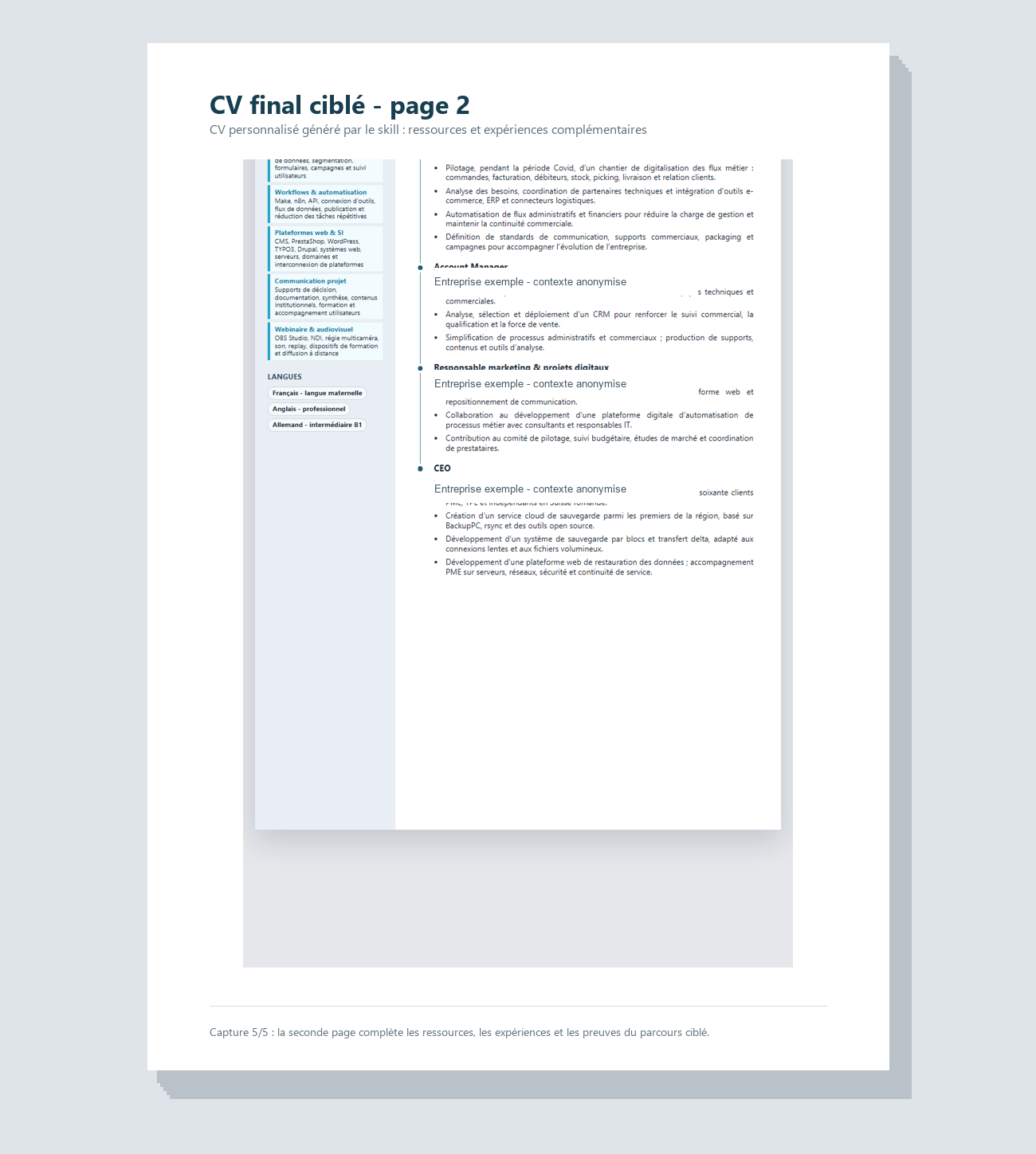
The gallery below shows the complete progression: the example announcement sets the expectations, the cover letter establishes the angle, and the final tailored CV provides the evidence. Personal contact information remains hidden, but the career path, skills, and selection logic are visible.
Generating a visually appealing, but above all readable CV
The visible part of the prototype is an HTML/CSS generator. The CV data is separated from the layout, then rendered in an A4 structure across two pages and exported as a PDF.
The technical choice is intentionally simple: HTML, CSS, a data file, and a browser-based export. It isn’t about spectacle; it’s about consistency of output: no broken text, clear hierarchy, compact blocks, balanced pages, correct accents, and a clean overall impression. Tools change, but the core skill remains the same: producing a dossier that HR can read quickly, understand quickly, and compare effortlessly.
The design serves HR readability. One column summarizes key information: contact details, transferable assets, skills, training, resources, and languages. The main column provides the profile and experiences with a clear timeline. Colors distinguish different types of information without turning the CV into an advertisement.
What AI actually brings to the table
The interesting point is not asking an AI to produce a CV in one click. That would be the least reliable part of the process.
AI becomes useful when applied to a methodology. Specifically, it serves to:
- analyze an offer;
- compare criteria;
- group skills;
- identify evidence;
- propose phrasing;
- verify consistency between the letter and the CV;
- power a PDF generator.
The nuance is important. General-purpose AIs are powerful, but they often remain generic: they help, they draft, they structure, but they easily produce expected texts if they lack real context. Here, the work consists of creating internal capabilities: an HR skill, a writing skill, a career memory, a selection logic, and a way of speaking that remains true to the individual.
In other words, AI does not write in place of the candidate. It helps make what already exists readable. It also forces a question that is often uncomfortable: what part of this journey actually responds to this specific offer?
A small nod to the system
There is naturally a touch of defiance in this approach. The job market requires candidates to be sober, precise, adapted, readable, and compatible with both HR codes and automated screening systems. It is better to take this constraint seriously and build a dossier that responds better without cheating.
For recruiters, the challenge is equally interesting: an application generated with method is not necessarily less authentic. On the contrary, it can be more honest than a generic CV because it forces every claim to be linked to evidence.
The question is therefore not just “Was AI used?” The real question is: “Does the dossier better tell the story of the relationship between a person, their actual skills, and the employer’s needs?”
A transferable method
While the prototype was built from a real profile, the method can be adapted for others: job seekers, people in career transitions, individuals with non-linear paths, employment coaches, or support organizations.
The value lies not only in the final PDF. It is in the clarification of the journey:
- transforming a sometimes scattered experience into resources;
- selecting useful evidence;
- formulating without inventing;
- producing a document that respects both the candidate and the recruiter.
The method can be built using ChatGPT, Gemini, Copilot, or other environments. The tool matters less than the context provided to it and the skills built around it. An AI that already accompanies a person in their daily projects does not start from zero: it can learn their vocabulary, their strengths, their areas of caution, their ambitions, and their way of working.
A tailored CV is therefore not a “made-up” CV. It is a way of choosing the most accurate professional face within a real journey to create a connection. In a market where applications are becoming more automated, the goal is not to produce the same dossier faster than everyone else. It is to produce a dossier that is fairer, clearer, and more faithful to what the person can truly contribute.